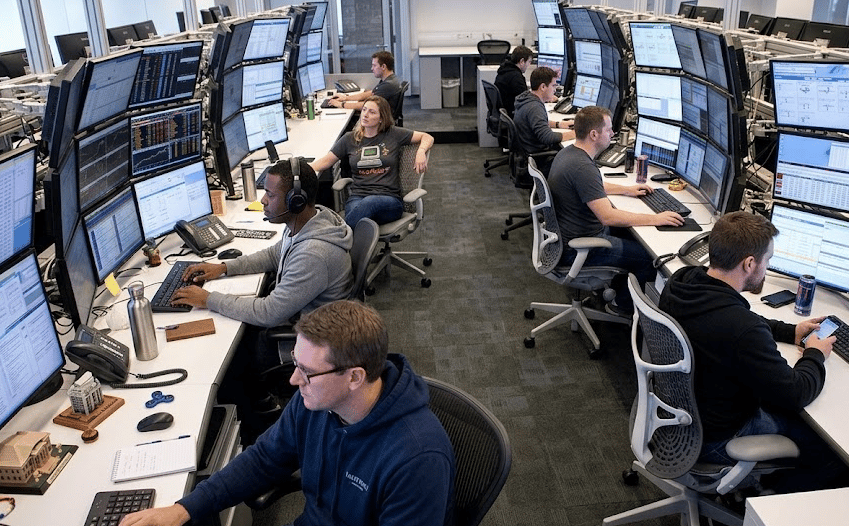
Prediction markets have gone from a retail curiosity to a business that serious quantitative trading firms now staff with dedicated desks. Susquehanna built the first one in 2023 and is now the flagship market maker on Kalshi. Jump Trading doubled its team to about 20 people in 2026 and took equity stakes in Kalshi and Polymarket. DRW is hiring a dedicated desk with base salaries up to $200,000, and Akuna is recruiting junior quant researchers for sports contracts. Behind the hiring wave sits an explosion in volume: from under $100 million a month in early 2024 to a record combined Kalshi and Polymarket total of $44 billion in June 2026.
The work is market making and relative value in binary contracts that settle at 0 or 1, where price equals implied probability. The edge is arbitrage, microstructure and disciplined pricing, not guessing outcomes, and the skills map almost exactly onto the standard quant trading interview: probability, expected value, Bayesian updating and market making games, with a domain layer of sports, politics or macro on top. This guide covers what is happening, which firms are involved, what the jobs actually are, the technical content a candidate should understand, and an honest read on whether it is a good early-career bet.
Why this is happening now
Two things changed at once: the legal path opened, and the volume arrived.
Prediction markets in the US sit under the Commodity Futures Trading Commission (CFTC) as event contracts, a type of binary derivative, rather than under state gambling law. The pivotal fight was Kalshi versus the CFTC over election contracts:
- 1September 2023. The CFTC orders Kalshi not to list congressional control contracts, a majority of commissioners calling them akin to gaming.
- 2September 2024. A US District Judge grants Kalshi summary judgment, finding the CFTC exceeded its authority. The DC Circuit briefly stays the order.
- 3October 2024. The DC Circuit denies the CFTC's emergency stay and Kalshi's election contracts go live. More than 500 million election contracts trade on Robinhood within a week of its presidential contract launch.
- 4May 2025. The CFTC voluntarily drops its appeal, ending the case in Kalshi's favour.
- 52025 onward. Kalshi self-certifies sports contracts, opening a second legal front with state gaming regulators, which remains live today.
Once elections were cleared, the volume followed. Kalshi reported $23.8 billion of notional volume in 2025, up 1,108% year on year across 97 million transactions. December 2025 alone set a monthly record of $6.38 billion. Combined Kalshi and Polymarket volume then reached a record $44 billion in June 2026, nearly double May's total, driven by the NBA Finals and the World Cup. Sports dominate: roughly 80% of Kalshi's volume, with its World Cup contracts alone generating around $27 billion.
One important caveat on every volume figure in this space: Kalshi counts volume as contracts multiplied by $1 face value and records both sides, so notional volume massively overstates dollars actually at risk and bears little relation to fee revenue. Treat volume as an activity indicator, not capital deployed.
Why do market makers care? The economics are the familiar market making economics, adapted to binaries. Exchanges court professional liquidity with reduced fees and higher position limits: Susquehanna became Kalshi's first official market maker on exactly those terms. Interactive Brokers' ForecastEx pays an incentive coupon, linked to the Fed funds rate, on capital tied up in positions. And the fee structure itself shapes where quoting is profitable:
Fees peak at the 50 cent price and fall to nearly zero at the extremes, which is where making markets is cheapest.
The structural attraction, in the words of one firm, is a market defined by inefficiency, fragmentation and the absence of mature pricing, which is exactly where quant strategies historically thrive.
The venue landscape
The regulatory opening produced a land grab for the regulated stack: a designated contract market (DCM) plus a derivatives clearing organisation (DCO).
| Venue | Regulatory status | What it trades | Notes |
|---|---|---|---|
| Kalshi | CFTC-regulated DCM | Politics, economics, weather, sports, culture, crypto | Volume leader; $23.8bn notional in 2025 |
| Polymarket | Offshore historically; US via the QCEX DCM | Broad, politics and sports heavy | Bought QCEX for $112m; ICE invested up to $2bn |
| Interactive Brokers ForecastEx | CFTC-registered DCM and DCO | Economic, climate, financial | Pays an incentive coupon on tied-up capital |
| CME Group / FanDuel Predicts | CME DCM; FanDuel FCM | Financial benchmarks, economic data, sports | Launched December 2025 |
| Crypto.com | CFTC DCM/DCO | Sports, events | Standalone app |
| Robinhood | Routes via Kalshi, ForecastEx and its own MIAXdx JV with Susquehanna | Sports, economics, events | More than 16 billion contracts in 2026 so far |
| Railbird (DraftKings) | CFTC DCM (June 2025) | Economics, culture, sports | Acquired by DraftKings October 2025 |
| PredictIt | Relaunched October 2025 | Politics only | Academic and political niche |
Which quant firms are involved
The evidence divides cleanly into committed participants, hedgers, and firms that have deliberately stayed out.
| Firm | Documented involvement |
|---|---|
| Susquehanna (SIG) | First dedicated desk (2023); Kalshi's first institutional market maker (April 2024); flagship Kalshi market maker as "Susquehanna Predictions" |
| Jump Trading | About 20 people on event contracts, doubled in 2026; equity stakes in Kalshi and Polymarket in exchange for liquidity provision |
| DRW | Building a dedicated desk; open trader and engineer roles with base to $200,000 |
| Akuna Capital | Prediction markets team; hiring junior quant researchers for sports contracts |
| Flow Traders | Increasing event-driven activity |
| Wintermute | Two-sided liquidity on Kalshi and Polymarket |
| Citadel Securities | Stayed out so far; its president calls entry "certainly possible" for non-sports use cases; hired Polymarket's former CTO |
| IMC | Reported both as staying out and as exploring binary event contract roles |
| Hudson River Trading | Stayed away so far |
Susquehanna deserves specific attention. SIG is culturally a probabilities-and-options firm with deep roots in sports analytics, and it treats event contracts as an asset class, not a novelty. Its head of prediction markets has described the firm as risk-neutral by default but willing to hold positions to provide hedges to clients, and its sports desk trades live in-game markets, correlated combinations and player-level props. It is the single best example of the thesis that an options market maker's skill set transfers directly to binaries. Separately, Susquehanna partnered with Robinhood to acquire MIAXdx as a DCM and DCO for a joint prediction markets exchange. If you are targeting the firm, our SIG interview guide covers the process.
The firms that stayed out matter for an honest assessment. As of 2026, Citadel Securities, IMC and Hudson River Trading were reported as having stayed away, citing lack of regulatory clarity and volumes that are still light relative to their core markets. Citadel Securities has since softened in public comments, while making clear it is not looking at sports. The reputational and gambling-classification risk is a real reason serious firms hesitate.
A specialist ecosystem is forming alongside the giants. Crypto-native market maker Wintermute, which processes more than $3.5 trillion in annual volume across 70-plus venues, confirmed in May 2026 that it quotes two-sided markets on both Kalshi and Polymarket. Small specialist funds in New York, Chicago and Geneva have been named as hiring, though most are thinly documented beyond a single round of reporting. The more interesting structural story is professional sports betting syndicates crossing over: the financial firms bring capital and execution infrastructure but often lack specialist sports pricing models, while the syndicates have spent decades pricing sport and modelling correlation. Kalshi's launch of combination contracts (parlays) in September 2025 is the specific product that pulled them in, because pricing correlated multi-leg risk is exactly their expertise. The crossover runs both ways: Jump hired a researcher who built sports betting models in his own time while working at a Big Four accounting firm.
What the job actually is
The postings are concrete and public. The core role types:
| Role | What it does | What it asks for | Hires new grads? |
|---|---|---|---|
| Prediction markets trader | Runs a live binary-contract book: market making with dynamic skew, cross-platform arbitrage, event-driven momentum | Quantitative reasoning, demonstrated passion for prediction markets, often personal Kalshi or Polymarket trading | Sometimes; passion and a track record can substitute for firm experience |
| Sports quant researcher | Builds pricing models for match outcomes, player props and in-game events | Python (C++ a plus), statistics, ML, a genuine interest in sports | Yes; Akuna's junior roles say so explicitly |
| Quant developer | Real-time pricing pipelines, cross-venue reconciliation, risk; venue APIs (Kalshi FIX/WebSocket, Polymarket CLOB) | Linux, concurrent high-throughput systems, a technical degree | Yes |
| Probability / event modeller | Estimates event probabilities and detects mispricing | Bayesian modelling, NLP sentiment parsing, ML for fair value | Varies |
Representative postings, with real detail:
- DRW, Prediction Markets Trader. A dedicated desk focused on Kalshi and Polymarket. Strategies listed: market making with dynamic skew, order-flow and book-imbalance microstructure plays, cross-platform arbitrage, sub-second news momentum, and statistical pairs. Base salary $175,000 to $200,000 plus discretionary bonus. The process runs a technical screen, a strategy discussion, and a live coding and modelling exercise on real prediction market scenarios.
- DRW, Software Engineer, Prediction Markets (Python). Base $150,000 to $225,000, owning pricing pipelines, cross-venue reconciliation and risk.
- Akuna Capital, Junior Quantitative Researcher, Prediction Markets (Chicago). Sports pricing models, data capture pipelines, in-play quoting. Minimum base $145,000 plus bonus, with prior trading-firm experience "valued but not necessary", and an explicit preference for people who have been trading Kalshi or Polymarket as a personal project.
- Susquehanna is recruiting to detect incorrect fair values and identify inefficiencies, plus a dedicated sports trader.
Compensation. The documented base ranges ($145,000 to $225,000) sit below top-tier mainstream quant trading new-grad total compensation, which runs roughly $250,000 to $450,000-plus at the very top firms per self-reported data. But those are base figures with undisclosed discretionary bonuses on top, so the comparison is not clean, and total comp for these specific desks is simply not publicly documented. One quant recruiter characterised 2026 hiring as selective and exploratory rather than large-scale desk building. Be sceptical of any precise total-comp number for this niche.
Geography. Chicago (DRW, Akuna, Jump), New York (the native funds), the Philadelphia region (Susquehanna), London (Wintermute), Amsterdam (Flow Traders) and Singapore. Several roles are explicitly remote or flexible, which is unusual for trading and reflects how new and small these desks are.
How binary contracts actually work
This is what separates a credible interview answer from a naive one. Each contract settles at $1 if the outcome happens and $0 if it does not, so a price of 40 cents is the market's implied 40% probability. That changes the geometry of trading:
- The payoff is bounded. Your maximum loss and gain per contract are both capped, unlike a linear instrument.
- Spreads and risk live in probability space. A 1 cent spread is a 1 percentage point spread in probability, which is enormous near the middle and trivial near the extremes.
- Quoting near 0 and 1 is dangerous. Selling a contract at 2 cents collects 2 cents to risk 98. You are writing deep out-of-the-money optionality, and one surprise wipes out hundreds of correct trades. This is the practical face of the favourite-longshot bias.
- There is often no continuous hedge. Many event contracts have no correlated liquid instrument to delta-hedge against, so inventory risk is carried all the way to resolution. Where a hedge exists, it is a different asset with basis risk.
- Adverse selection is acute. In a market about a real-world event, the person lifting your offer may simply know something you do not. The insider trading cases covered below are the extreme version of the everyday adverse-selection problem a maker faces.
Most regulated US event contracts are also fully collateralised: every position is backed dollar for dollar with no margin, which is capital-intensive relative to futures and a real drag on returns. That is starting to change now that Kalshi has approval for an affiliate to operate as a Futures Commission Merchant, the first step toward margin.
The arbitrage playbook
The bread and butter of the desks is relative value, not outcome prediction:
- Cross-venue arbitrage. The same event priced differently on Kalshi and Polymarket, or versus a sportsbook line. Buy Yes on the cheaper venue and No on the other so the two legs cost less than $1. The frictions are real: you must pre-fund both venues, fees eat thin edges, and settlement risk is the killer, because if the two venues resolve the same event differently you lose both legs.
- Mutually exclusive sets that must sum to 1. Where exactly one outcome resolves Yes, the Yes asks across all outcomes should sum to about 100 cents. If they sum to less, buy the whole field and lock a profit; if the bids sum to more, sell the field.
- Arbitrage against traditional instruments. CPI contracts against inflation swaps or TIPS breakevens; Fed decision contracts against fed funds futures and OIS; sports contracts against sportsbook lines. This is where the incumbents' existing books give them a structural advantage.
- The longshot bias. Systematic overpricing of low-probability contracts is a documented, persistent edge source.
The calibration evidence is worth quoting accurately in an interview. Prediction markets are generally well calibrated, with typical Brier scores in the 0.15 to 0.25 range, better than expert panels. They are most efficient in the middle and at the high-probability end, and least efficient in the low-probability tail: a study of Kalshi unemployment contracts found contracts priced below 30 cents significantly overpriced, with an actual win rate of about 4%. Efficiency also varies by category, with Fed and interest-rate markets near-perfectly calibrated and employment markets the weakest. The practical implication: respect the base rate, hunt the low-probability tail and thin markets for edge, and track your own Brier score against the market's as a feedback loop.
The single biggest non-market risk is resolution. Read the resolution source and rule, not the headline. Polymarket settles contested markets via UMA's optimistic oracle, where token holders vote, and this has produced repeated controversies, including a multi-hundred-million-dollar market flipping resolution amid manipulation claims and more than 1,150 disputed markets logged in 2026. For a quant, oracle risk is a priced, real tail.
The risks and the bear case
A decision-ready view has to weigh the bear case fairly.
- Regulatory risk is the dominant risk. State gaming regulators in New Jersey, Nevada, Maryland, Ohio, New York and elsewhere, plus tribal gaming interests, are actively litigating whether sports event contracts are unlicensed betting. Kalshi has won important early rounds on CFTC preemption, including preliminary injunctions in Nevada and New Jersey and a November 2025 win against a California tribal challenge, but several cases remain live and a CFTC rule change is possible. If sports contracts are curtailed, roughly 80% of current volume is at risk.
- Market integrity. Insider trading on event contracts is not hypothetical: a US Army master sergeant was charged with using classified information to profit on a contract about the capture of Venezuela's Maduro, the first US case of its kind, and Kalshi has disclosed opening around 200 investigations. This is both a reputational risk and a live adverse-selection cost for market makers.
- Durable asset class or hype cycle? The bull case: real hedging use cases, genuine information aggregation, and serious institutional infrastructure commitments (ICE's investment of up to $2 billion in Polymarket, CME and FanDuel launching, DraftKings buying Railbird). The bear case: volume is dominated by sports and concentrated in a small active cohort, around 75% of Kalshi users reportedly never trade, notional volume overstates real capital, and the markets are still too thin to absorb institutional size. The honest read is that market making and relative value are already viable at modest scale, but the "serious institutional asset class" thesis is not yet proven.
How it maps to the interviews
The good news: the core of a prediction markets interview is the core of any quant trading interview. Probability and expected value, Bayesian updating, market making games, calibration and estimation, and mental arithmetic all map directly. What is specific to the niche: binary payoff intuition, thinking in probability space, the favourite-longshot bias, cross-venue and mutually-exclusive-set arbitrage, and resolution risk. All of that specific layer is teachable, and we built a dedicated track for it: the Prediction Markets Trading course covers the concepts lesson by lesson, and the Prediction Markets Trainer drills them against the clock.
Some example questions with answer sketches, written for this guide:
1. A contract pays $1 if it rains in Chicago tomorrow, else $0. Your model says 30%. The market is 25 bid at 28 offered. What do you do? Buy at 28 cents. Your fair value is 30, so the edge is 2 cents per contract before fees. Note that you cannot hedge this directly, so size it for the variance: the position is all-or-nothing at resolution.
2. Three mutually exclusive candidates trade at 55, 30 and 12 cents Yes. Is there a trade? They sum to 97 cents. Exactly one resolves Yes and pays $1, so buying all three locks in 3 cents, before fees and assuming the set is genuinely exhaustive and the fills are simultaneous. Check for a missing "other" outcome and fee drag before claiming it is risk-free.
3. A contract has traded at 4 cents for weeks. Would you sell it at 4? Be very careful. You collect 4 cents to risk 96, so you need to be right more than 96% of the time just to break even, and this is exactly the region where prices are documented to overstate true probability and where one informed trader ruins the trade. This is the longshot trap.
4. The same event is 60 cents Yes on Kalshi and 55 cents Yes on Polymarket. Free money? Only if the resolution criteria are identical, both legs fill, fees are covered, and both venues are pre-funded. Buy Yes at 55 on Polymarket and No at 40 on Kalshi, 95 cents in total for a guaranteed $1. The risk is that the venues resolve the "same" event differently, or one leg moves before the other fills.
5. The market says 70% but you believe 80%. How much should that move you? The market aggregates many views; your single view must be genuinely well-informed to override it by 10 points. State your prior, the specific information you have that the market may not, and update accordingly. Interviewers want calibrated humility, not overconfidence.
The firms with the biggest desks all run standard quant processes first, so practise the real formats:
How to break in, and whether you should
Build the general quant foundation first: probability, statistics and market making are the gate, and they transfer regardless of what happens to prediction markets. Then add the niche fluency, because firms explicitly value it and it is the cheapest differentiator available:
- Trade small on Kalshi or Polymarket to understand fills, fees and resolution mechanics first-hand.
- Build a calibration tracker. Log your own forecasts, compute your Brier score, and compare it against the market's. This is exactly the feedback loop the desks run, and the one our Event Contracts Game scores every round.
- Build a small cross-venue scraper and fair-value model. Even a simple one that flags sum-to-one violations demonstrates you understand the actual edge sources.
- Put the project on your CV. Akuna and DRW both explicitly ask for personal prediction markets experience.
The honest downside: the skill transfer is narrower than a mainstream seat if you over-specialise, the desks are small and could be scaled back if regulation turns, the gambling stigma is real, and total compensation for the niche is undocumented and probably below top mainstream seats today. The upside: it is a young, inefficient market where a junior can have outsized impact, the intellectual content is rich, and the core skills transfer if you keep them general.
A sensible framing is to target a firm with both a mainstream book and a prediction markets desk, so you are not betting your whole career on one asset class. Susquehanna, Jump, DRW and Akuna all fit that description, and in the interview, talk about prediction markets the way the desks do: arbitrage, microstructure, calibration and risk, not predicting outcomes.
FAQ
Are prediction markets just gambling?
Legally, in the US, regulated event contracts sit under the CFTC as derivatives, and courts have so far upheld that framing against state gaming challenges for election contracts and in early sports rounds. Economically, quant firms treat them as binary options with an information-aggregation function. The gambling classification fight is precisely the live regulatory risk.
Do I need to know sports or politics to work on these desks?
For sports contract roles, yes: a genuine domain interest is asked for explicitly. For arbitrage, microstructure and engineering roles, the quant skills matter more than domain knowledge.
Do prediction markets desks hire new graduates?
Some do. Akuna's junior sports researcher roles say prior trading-firm experience is valued but not necessary, and DRW's trader role weights demonstrated passion and personal trading. Engineering roles hire grads routinely.
How is pricing a binary contract different from pricing a stock?
The payoff is bounded and settles at 0 or 1, price equals implied probability, spreads and risk live in probability space, quoting near the extremes is dangerous, and there is often no continuous instrument to hedge against.
Is prediction markets trading a safe career bet?
It is a promising but narrower and riskier bet than a mainstream quant seat, mainly because of regulatory risk and desk immaturity. Keep your core skills general and target firms that also run mainstream books.
Start preparing
Everything these desks test is trainable, and we built the full track for this niche. Start with the Prediction Markets Trading course for the concepts, from probability-space geometry through arbitrage locks to Kelly sizing under full collateral, then move to deliberate practice:
Around that core, make probability and expected value automatic with the probability brainteasers and the Probability Trainer, sharpen your estimation and calibration with the Fermi questions, and keep your arithmetic fast with the Math Trainer. When you know where you are applying, work through everything we have for that firm, and read the Ultimate Guide to Quant Trading Interviews before your first stage.