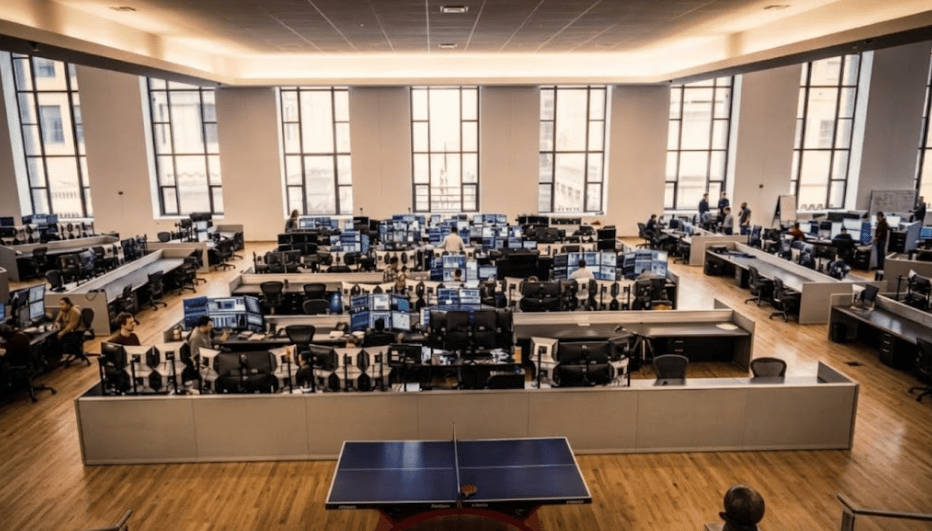
PEAK6 Capital Management is a proprietary options trading firm and market maker that has provided liquidity to the options market for more than 25 years. Its co-founders Jenny Just and Matt Hulsizer, both formerly at O'Connor, started it in Chicago in 1997 with $1.5M of seed capital. The wider PEAK6 group moved its global headquarters to Austin on 1 January 2025, while the trading business describes itself as headquartered in the Chicago Board of Trade, with a New York office as well. The group has around 1,900 people, and the trading arm is a few hundred of them.
The firm says it holds options positions for days or years rather than microseconds, and it stresses fit in hiring. Candidates notice: one said that fit was stressed a lot in their interviews. It has run a trading internship for women since 2016, which by 2021 had trained 40 women and brought the firm's trading floor to 35% female.
We found no 12-minute maths test in any candidate report or on PEAK6's own pages. The online assessment is a short IQ-style test of pattern puzzles, number sequences and basic probability and expected value, and it reportedly has no pass mark. The timed mental maths that candidates talk about happens live in the first interview: about 30 questions in 4 minutes, often read aloud.
- 1Application and online assessment. An IQ-style test with probability and expected value, about a week to complete.
- 2Recruiter call. A short outline of the process and your background.
- 3First interview. 1 hour on Zoom, usually 2 back-to-back 30-minute sessions with traders, one behavioural and one technical with the 4-minute maths round.
- 4Final round. A half day on Zoom according to the firm, or an in-person Chicago superday according to 2024 and 2025 intern reports, with market making games.
PEAK6 says it may take up to 2 weeks to tell you the decision after the final. Candidates describe anything from about 2 weeks to 2 months end to end.
The programmes
| Programme | Who | Dates and pay |
|---|---|---|
| Trading Experience for Women+ | Women-identifying college juniors | 9 weeks, June to August, Chicago, travel and housing covered. Applications from July with interviews through the fall |
| Trading Bootcamp | Juniors graduating between December 2026 and June 2027 | 1 week at the Chicago Board of Trade, in May or August. $25 to $31.25 per hour with flights and housing. Applications from August, interviews from January |
| Trading Associate 2027 | Bachelor's or master's students graduating between December 2026 and June 2027, starting August 2027 | An 18-month programme in 4 phases: basic training, basic trading, rotations, then your own portfolio. Series 57 within 2 months. Austin, Chicago or New York. $100,000 to $125,000 base plus a discretionary bonus |
| Software engineering internships | Students | Chicago and Austin, across the trading business and the group's fintech arm. Up to $50 per hour on some postings |
We found no student quant programme. The Trading Associate posting says associates explore both automated and discretionary trading and should be willing to learn to code.
Stage 1: Online assessment
| Item | What candidates report |
|---|---|
| Platform | Not named in any source. Candidates call it an IQ test or a Raven's matrices test |
| Content | Picture puzzles ("what picture is the most logical option?"), number sequences, basic probability and expected value, logic |
| Count and time | Timed, but no recent count. The only count on record is old: about 15 probability and 15 IQ-style questions. Older reports describe 10 maths problems with a per-question clock, and a long personality survey that no recent report mentions |
| Difficulty | Candidates describe very basic probability and expected value at a standard difficulty, and rate it among the easiest online tests in the industry, though the clock can feel tight |
| Scoring | The firm has said there is no pass or fail |
| Window | About 1 week |
| Example | 1, 4, 9, 16, ?, 36 |
The 12-minute figure that readers ask about matches the Wonderlic format of 50 questions in 12 minutes, but no source links Wonderlic to PEAK6. If your invitation names a 12-minute test, tell us what you saw and we will update this guide.
Engineers get a different test: a HackerRank of 2 questions in 60 to 90 minutes, sometimes Python only, at LeetCode medium to hard. A flight landing scheduling problem similar to merge intervals is reported several times, and the autograder is strict about types: return an integer where one is asked for, not a double.
How to prepare
Half an hour on matrix and figure puzzles, then number sequences on the Sequence Trainer, then basic expected value on the probability trainer. Engineers should work interval problems in the coding practice catalog.
Stage 2: First interview
The firm's campus page describes 1 hour on Zoom with a mix of technical and behavioural questions. Candidates describe 2 back-to-back 30-minute interviews with traders, one behavioural and one technical, sometimes with an HR interviewer as a third.
The 4-minute maths round
Candidates have described this round since 2020. You have 4 minutes to solve as many of about 30 mental maths questions as you can: addition, subtraction, multiplication, division, and a couple of the form "what is 35% of 1,200". It is often oral. Good scores on written speed tests like 80-in-8 or Zetamac do not carry over on their own: hearing the numbers instead of seeing them is the hard part. Another lost time asking for a question to be repeated 10 times. It is not always announced in advance.
The technical questions
- Expected value and bet sizing. The expected value of 3 scenarios given a bankroll and odds, with a view on risk tolerance. Bet sizing. Expected value and variance.
- Games. Roll a die: stop unless it is a 6, then keep rolling until you have rolled three 6s, paid 6, 36 and 216 for the first, second and third. What is it worth?
- Counting. How many ways 3 people can finish first, second and third.
- Processes. A stock moves up with one probability and down with another each day. What is its expected value after z days?
- Fermi. How many trees are there in the world? Market sizing questions.
- Open logic. What is the probability intelligent life has visited Earth?
Behavioural questions are standard: why this internship, a difficult experience, a bad decision, how you handle failure, what motivates you, your hardest class, and current financial facts.
How to prepare
Have someone read arithmetic questions to you against a 4-minute timer, and practise answering without writing. The Math Trainer builds the speed, and the oral drill builds the specific skill the round tests. Percentages of round numbers deserve their own session. For the technical questions, work the expected value against an optimiser and Kelly criterion lessons, the cards and coins collection and the Fermi questions. Rehearse why trading and a specific answer to why PEAK6.
Stage 3: Final round
The format varies. The campus page says a half day on Zoom meeting leadership and future team members. 2024 and 2025 interns describe a superday in the Chicago office, sometimes with a networking event the evening before, and a full day of logic games, lunch and behavioural interviews. Older full-time reports describe 6 to 9 rounds of 30 minutes, including card games, shadowing traders, an escape room and a mock trading exercise, and candidates call the day exhausting.
Market making, confirmed
- A market on the sum of six dice. The dice are thrown one at a time, you adjust your market after each throw and trade on it. Applicants quote first, and if things go stale the interviewers step in with obviously low or high offers. You keep track of your position and your net profit and loss.
- A market on the sum of several coin tosses.
- A group market game with the other interviewees, in some versions.
Other games and cases
A card game with betting, where you estimate how much to bet from the probability and expected value of winning. An options trading game. A written coding challenge in a made-up language, and Python pseudocode on paper for logic problems. A retrospective analysis of trading strategies, an odd case study, and the occasional random technical question such as why the sky is blue.
How to prepare
Play the dice game until quoting, requoting after each throw and tracking your position are automatic, then the card game, and read our guide to make me a market. Do it without pen and paper. The betting board game covers the card-betting exercise, and the market making lesson explains what the interviewer stepping in with an off-market offer is testing.
Engineering interviews
After the HackerRank, a video technical interview, then an onsite or virtual final. Software engineers have 5 sessions: 1 coding, 1 system design, 1 technical without coding, and behavioural interviews, with the coding based on a practical problem from the trading space. Reported problems include a stock exchange close to a real application, reading stock quotes from a socket, and a 2-hour technical onsite. Candidates complain about slow scheduling, with one process taking almost 2 months of emails.
Key tips for success
- Prepare oral arithmetic specifically. Scoring well on a typed trainer does not transfer by itself.
- Expect expected value in every technical conversation, with your bankroll in the question.
- Practise the sum-of-dice market, because it is the one game reported again and again.
- Take the behavioural half seriously. Fit is stressed, and the superday is largely conversation.
- Ask for the format. The firm's page says Zoom and recent interns say Chicago.
Closing remarks
PEAK6's process is easy at the gate and specific after it. The online test filters few people. The first interview tests whether you can do arithmetic out loud at speed and whether you think in expected value and bet size. The final asks you to make a market on dice with traders pushing against you, then spends hours on whether you fit. Candidates who train oral maths, expected value and the dice market, and who have a real answer to why PEAK6, are well placed.
Work through everything we have for PEAK6, and read our full interview guide for how these stages compare across firms.