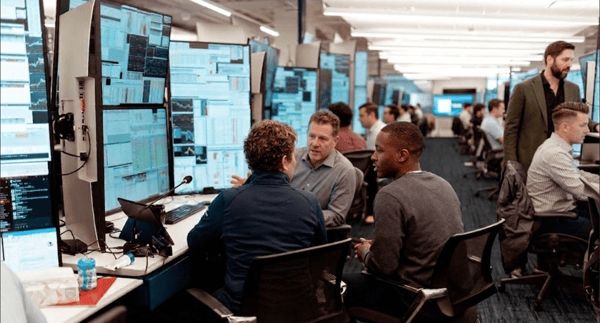
Quant trading, short for quantitative trading, is the use of mathematical models, statistical analysis and computer programs to decide what to trade, when to trade it, and how much to hold. Instead of a human reading a chart and acting on a view, a quant trader defines every rule in code, tests it against historical data, and lets systems execute it. The edge comes from a measurable statistical advantage repeated across thousands of trades, not from a single well-timed call.
That distinction runs through everything below: who does the work, how the firms are built, what they pay, and how you break in. This guide is the substance behind the interview. If you want the process itself, our Ultimate Guide to Quant Trading Interviews covers every stage from CV screen to superday.
What does "quant trading" actually mean?
A discretionary trader might decide a stock looks cheap after reading the news and studying a chart. A quant trader writes a model that defines "cheap" in precise terms, tests that definition against decades of data, accounts for transaction costs, and deploys it only if the edge survives. Every assumption is explicit and every outcome is measurable.
Quantitative methods now dominate market activity. Industry estimates put algorithmic and high-frequency strategies at nearly 65% of US equity trading volume by 2024, up from about 45% in 2010, and systematic strategies drive a growing share in Europe and Asia. The firms that do this best are among the most profitable financial institutions ever built: Bloomberg reported that Jane Street generated a record $20.5 billion in net trading revenue in 2024, more than Bank of America or Citigroup, with net income of $13 billion from roughly 3,000 employees, and Citadel Securities posted $9.7 billion in net trading revenue the same year, a 55% increase.
Three terms get used loosely and are worth separating:
- Quantitative trading is about the decision: using models and statistics to decide what to buy or sell.
- Algorithmic trading is about execution: using programs to place and route orders efficiently. A bank running a VWAP algorithm to fill a client order is doing algo trading with no quant model behind the decision.
- Quantitative research or investing is the broader field of applying maths to markets, including derivatives pricing, portfolio construction and risk, some of which never touches short-horizon trading.
Most modern quant trading is also algorithmic, but not all algorithmic trading is quantitative, and not all quant finance is trading.
Quant trading vs discretionary trading
| Dimension | Quant trading | Discretionary trading |
|---|---|---|
| Decision maker | Model, defined in code | Human judgement |
| Basis of edge | Statistical advantage over many trades | Information, insight, timing |
| Number of positions | Hundreds to thousands at once | A handful to dozens |
| Holding period | Microseconds to months | Days to years |
| Emotion | Removed by design | A constant factor to manage |
| Scalability | High, limited by capital and capacity | Low, limited by human attention |
| Core skills | Maths, statistics, programming | Market knowledge, pattern recognition |
How does quant trading work?
Quant trading runs as a pipeline, and a weakness at any stage undermines the whole thing.
- 1Data. Historical prices, live order book snapshots, fundamentals, and alternative datasets like satellite imagery, card-spend or shipping flows. Raw data has to be cleaned, adjusted for corporate actions such as splits and dividends, and stored for fast retrieval. Large firms handle terabytes updated in real time.
- 2Signal research. Researchers look for statistical relationships between what they can observe and what prices do next. A signal can be simple, such as short-term mean reversion in oversold stocks, or a machine learning model combining dozens of features to predict next-day returns across thousands of names.
- 3Backtesting. Before real capital is committed, the strategy is simulated on historical data, net of transaction costs, slippage and market impact. Serious firms use out-of-sample testing, walk-forward analysis and multiple market regimes.
- 4Execution. Signals become orders. For slow strategies this means slicing a large order to limit market impact. For fast strategies it means colocated servers, kernel-bypass networking and sometimes hardware, measured in microseconds and nanoseconds.
- 5Risk management. Position limits, sector and factor exposure limits, drawdown thresholds and automated kill switches sit alongside every step. If a book breaches its risk budget, positions get cut automatically.
The traps in backtesting are well known: lookahead bias, survivorship bias and overfitting. A backtest that looks perfect and dies live is the single most common way a strategy fails, which is why firms weight out-of-sample evidence so heavily.
A worked example: capturing the spread
Take a market maker quoting Tesla at a bid of $250.10 and an ask of $250.15. It buys 100 shares at the bid and sells 100 at the ask, earning $5 minus fees on the round trip. That is trivial in isolation. Repeated across thousands of names and millions of trades a day, with tight inventory control so the firm ends the day roughly flat, it becomes a multi-billion-dollar business. This is why market making rewards speed, breadth and risk control rather than any single big call.
Quant trader vs quant researcher vs quant developer
"Quant" covers several distinct jobs. The lines blur at smaller firms, but the archetypes are clear.
| Role | Owns | Typical background | Day-to-day |
|---|---|---|---|
| Quant trader | Live risk and P&L | Maths, strong mental arithmetic, fast decisions | Monitors and adjusts strategies in the market, overrides models on exceptions, manages inventory and risk |
| Quant researcher | Signals and models | PhD or strong MSc in maths, physics, stats, CS | Finds and tests alpha, builds and validates models, runs backtests |
| Quant developer | Systems and infrastructure | CS, strong software engineering | Builds low-latency execution, data pipelines, backtesting frameworks and risk systems |
| Quantitative analyst | Pricing, risk, valuation | Financial engineering, stochastic calculus | Prices derivatives, builds risk models, often sell-side |
The split matters by firm type:
- Prop firms and market makers (Jane Street, Optiver, IMC, Citadel Securities, SIG, Flow Traders, DRW, Jump, HRT, Tower, Five Rings) tend to run trader, researcher and developer tracks side by side, with traders owning short-horizon risk directly.
- Quant hedge funds (Two Sigma, DE Shaw, Renaissance, AQR, Man AHL, Qube, Squarepoint) put researchers at the centre, since they build the models that trade the capital.
- Sell-side banks (Goldman Sachs, JP Morgan, Morgan Stanley) lean toward quantitative analysts for pricing, structuring and risk, with proprietary risk-taking constrained by post-2008 rules such as the Volcker Rule.
For a sense of what the trader role feels like hour by hour, see A Day in the Life of a Quant Trader.
The main quant trading strategies
Quant trading is a family of strategies, not one thing. The main families:
- Market making. Continuously quote a two-sided price and earn the bid-ask spread while managing inventory. The largest segment of the electronic trading industry: Optiver, IMC, Citadel Securities, Jane Street, Flow Traders and Virtu are built on it.
- Statistical arbitrage. Trade baskets of related securities that have diverged from their usual relationship, betting on convergence. Holding periods run from hours to weeks; a common rule enters when a spread is more than 2 standard deviations from its mean and exits near the mean. Well-run stat-arb books typically target Sharpe ratios in the 1.5 to 4 range.
- Latency and HFT arbitrage. Exploit tiny, fleeting price differences between related instruments or venues, for example an ETF versus its underlying basket, or a stock versus its futures. Pure speed play.
- Mid-frequency systematic. Signals held from minutes to days, combining many weak predictors. Less about raw speed, more about research quality and breadth.
- Options and volatility trading. Price and trade options, hedge the Greeks, and take positions on implied versus realised volatility. SIG, Optiver, IMC, Akuna and Maven are known for it.
- ETF arbitrage. Keep an ETF price in line with its underlying basket through the creation and redemption mechanism. Jane Street and Flow Traders are dominant here.
- Basis and futures trading. Trade the relationship between a future and its underlying, or between related futures.
- Trend following and CTA. Systematically ride medium-term trends across futures markets. Man AHL and Winton are classic examples.
- Index arbitrage and event-driven systematic. Trade index-level dislocations or systematic responses to scheduled events such as earnings or index rebalances.
How frequency buckets differ
| High frequency (HFT) | Mid frequency (MFT) | Low frequency (LFT) | |
|---|---|---|---|
| Holding period | Microseconds to minutes | Minutes to days | Days to months |
| Edge source | Speed and queue position | Signal quality and breadth | Deep research, capacity |
| Infrastructure | Colocation, FPGAs, microwave | Fast but not bleeding-edge | Modest, research-heavy |
| Capacity | Low (small size, huge turnover) | Medium | High (absorbs large capital) |
| Team shape | Small, engineering-heavy | Mixed | Researcher-heavy |
| Typical firms | Citadel Securities, HRT, Jump, Tower | Many prop and multi-strat pods | Two Sigma, AQR, DE Shaw funds |
Higher frequency means a cleaner, more repeatable edge per trade but a brutal technology arms race and low capacity. Lower frequency means a noisier edge but room to deploy large capital.
The technology and infrastructure stack
Technology is not a support function in this industry; it is the product.
- Languages. Python dominates research, prototyping and data work through NumPy, pandas, scikit-learn and PyTorch. C++ is the standard for low-latency production systems, with Rust increasingly used for new systems work. Jane Street famously uses OCaml across its trading and research systems. FPGA work in Verilog or VHDL sits at the fastest firms such as Optiver and Tower.
- Latency. For the fastest firms, tick-to-trade latency, the time from receiving a market update to firing an order, runs in the hundreds of nanoseconds using FPGAs, versus roughly 1 to 10 microseconds for optimised software with kernel bypass. Building an FPGA trading system can take years and cost millions.
- Colocation. Firms rent rack space inside exchange data centres, such as the NYSE facility in Mahwah, New Jersey, to cut the physical distance to the matching engine to a few metres of cable. Some use microwave links between data centres because light travels faster through air than through fibre.
- Data infrastructure. Time-series databases such as kdb+, distributed compute, and pipelines that serve both historical research and real-time trading.
- Backtesting and execution. A research stack for simulating strategies, and an execution stack for order routing across venues and execution algorithms such as VWAP, TWAP and implementation shortfall.
The data and risk side
Data is the raw material of alpha. Firms consume market data (top of book and full order book depth), reference and fundamental data, and increasingly alternative data. The competitive frontier has shifted from having the data to cleaning, labelling and combining it well.
Risk management is what keeps a firm alive across regimes. The main tools:
- Position, sector and factor exposure limits.
- The option Greeks (delta, gamma, vega, theta) for anything with optionality.
- Value at Risk (VaR), which estimates a loss threshold at a given confidence over a horizon. VaR is useful but has real limits: it says nothing about the size of losses beyond the threshold, it assumes the past resembles the future, and it can understate tail risk badly in a crisis.
- Automated kill switches that flatten positions when limits break, including hardware kill switches at the fastest firms.
The 2007 "quant quake", when crowded stat-arb books unwound simultaneously, is the classic reminder that market-neutral does not mean risk-free.
Who are the major quant firms?
The industry clusters into three broad groups, with a fast-growing crypto segment alongside.
Market makers and prop firms trade their own capital, focus on short horizons and liquidity provision, and pay juniors the most:
- Jane Street, Citadel Securities, Optiver, IMC, SIG, Flow Traders, DRW, Jump Trading, Tower Research, Hudson River Trading, Virtu, Old Mission, Belvedere, Five Rings, Akuna, Maven, Mako.
Quant hedge funds raise outside capital and run systematic strategies over longer horizons:
- Two Sigma, DE Shaw, Renaissance Technologies, AQR, Man AHL, Qube, Squarepoint, PDT Partners, plus the systematic arms and pods inside Citadel, Millennium and Point72. XTX Markets and Hudson River Trading blur the line, running both fast market making and longer-horizon systematic books.
Crypto market makers provide liquidity in digital assets:
- Cumberland (DRW), Jump Crypto, Jane Street, GSR, B2C2, Wintermute, Amber Group.
A few numbers give the scale. Renaissance's Medallion fund is the most extreme track record in finance: widely cited estimates put its average annual gains before fees at about 66% since 1988, roughly 39% after fees, and an academic reconstruction puts the gross compound return at 63.3%, growing $100 into roughly $398.7 million by the end of 2018. It has been closed to outside investors since the 1990s. XTX Markets posted a record £1.28 billion net profit in 2024, up 54% from £835 million, according to Companies House filings; founder Alex Gerko alone earned £682 million. Hudson River Trading's net trading revenue reached nearly $8 billion in 2024. On the fund side, Citadel manages roughly $68 billion, and DE Shaw and Two Sigma around $60 billion and $51 billion respectively.
How much do quant traders earn?
Compensation in quant trading is among the highest in finance, and it is dominated by bonus and profit share rather than base. A few ground rules before the numbers:
- Firms publish almost nothing. Most figures come from self-reported data on levels.fyi, Glassdoor and Reddit, plus recruiter surveys and, in the UK, Companies House filings. Self-reported data skews high because people who did well are the ones who post.
- Pay is bonus-heavy. Base is typically 30% to 50% of total at prop firms; the rest is performance-driven and often partly deferred.
- Headline year-1 totals are inflated by one-off signing bonuses and first-year guarantees that do not repeat.
US total compensation by role and seniority (self-reported, 2026)
| Role | New grad | Mid-level | Senior |
|---|---|---|---|
| Quant trader | $250k to $450k+ | $400k to $800k | $600k to $1.5m+ |
| Quant researcher | $225k to $400k | $350k to $700k | $500k to $1.2m+ |
| Quant developer | $200k to $450k | $300k to $600k | $500k to $1m+ |
New-grad trader total comp at top firms such as Jane Street, Citadel Securities and Jump has been reported around $450k to $650k for strong performers, of which base is roughly $250k to $375k. Jane Street's public job posting lists a $300,000 base for a New York quantitative trader, before a discretionary bonus. At the very top, a handful of senior traders and partners earn into eight figures in strong years.
By region (entry-level, total first-year compensation)
| Region | Graduate trader total comp | Notes |
|---|---|---|
| US (New York, Chicago) | $400k to $700k at top firms | Highest nominal pay; bonus-heavy |
| London | £150k to £250k at top firms | Broader grad market £80k to £180k |
| Amsterdam | Around €150k to €250k | Low fixed base plus large profit share |
| Hong Kong / Singapore | Wide; exceptional cases much higher | Lower tax; thin grad-specific data |
Regional figures are softer than the US ones. In London, top firms such as Jane Street, HRT, Citadel Securities and Optiver reportedly pay first-year hires £150k to £250k total, while the broader graduate quant trader market sits lower: Glassdoor's self-reported "graduate quant trader" average for London is around £68k, a figure that captures banks and smaller firms and drags the average down. Amsterdam firms such as Optiver, IMC and Flow Traders pay a low fixed base with a profit-share bonus that dominates total pay from year one. In Asia, pay is wide and data is thin; one widely cited report had Jane Street offering an elite graduate a package worth around $508k to trade in Hong Kong, including relocation, which is a top-of-market outlier rather than a typical grad number. Singapore graduate quant roles are indicatively reported at roughly SGD 80k to 150k.
The pattern is consistent everywhere: base differs modestly by office, and profit share is what separates firms and years.
What backgrounds and skills do firms hire for?
There is no single required degree. The common backgrounds are maths, physics, computer science, statistics, engineering and econometrics. What firms actually screen for:
- Mathematical ability, especially probability and expected value, which is the single largest theme in trading interviews.
- Programming, with Python as a near-universal minimum and C++ for latency-sensitive roles.
- Fast, accurate mental arithmetic and composure under time pressure, tested directly in online assessments and interviews.
- Signals of raw problem-solving: maths olympiads, competitive programming, top-tier academic records, and games like poker and chess.
Do you need a PhD? It depends on the role. For quant research at hedge funds like Renaissance, Two Sigma and DE Shaw, PhDs are common and sometimes expected; practitioner estimates put the PhD share of quant-research hires at those firms at roughly 40% to 60%. For quant trading and quant development at prop firms, a PhD is rarely required and often not preferred; strong undergraduates and master's candidates are hired every year. The consistent message from practitioners is that firms hire for how quickly you learn and how well you reason, not for the title on your degree.
If you are choosing what to read, our guide to the best books for trading and quant interviews covers the standard references.
What does the interview process look like?
At a high level, quant trading interviews follow a common five-stage shape, though formats vary by firm:
- CV and application screening, filtering for academics, quantitative ability and genuine interest.
- Online assessments, timed tests of mental arithmetic, sequences, probability and logic. Usually the first real elimination round.
- HR or recruiter call, on motivation, fit and basic market awareness.
- Technical interviews with traders: brainteasers, probability and expected value, market-making games, and estimation.
- Final round or superday, back-to-back interviews with a case study or trading simulation and a senior fit conversation.
The through-line is that interviewers care more about how you reason than whether you land the final answer. Our Ultimate Guide to Quant Trading Interviews walks through each stage in detail, and How to play "Make me a Market" covers the exercise that most resembles the job itself.
What is the day-to-day reality?
A quant trader's day is shaped by the market's clock and the research that fits around it: overnight review before the open, fast execution and monitoring during the day, then reconciliation, P&L and research after the close. Traders rarely leave the desk mid-session because a few seconds of missed reaction can move P&L. Researchers spend most of their time on the slow loop: forming hypotheses, testing them and discarding the many that fail. Developers keep the systems fast and correct.
The parts people underestimate: it is as much communication and teamwork as maths, the learning never stops, and the feedback is immediate because P&L lands every day. For the full hour-by-hour picture, read A Day in the Life of a Quant Trader.
Pros, cons and common misconceptions
Pros: high pay, intellectually demanding work, immediate feedback, meritocratic desks, and problems that stay interesting.
Cons: intense competition to get in and to stay, long hours, strategies that decay and must be constantly replaced, high-pressure P&L accountability, and real attrition. The often-cited "median of survivors" pay figures exist precisely because many people do not survive the first few years.
Misconceptions worth killing:
- "It is passive income from a bot." Institutional quant trading is a large, capital-intensive, team-based operation, not a script running from a laptop.
- "You need a PhD." Not for trading or development roles.
- "It is pure maths." Communication, teamwork and composure matter as much as technical skill.
- "Backtests equal profits." Overfitting and biased backtests are the most common way strategies fail.
- "Quant means HFT." HFT is one slice; mid- and low-frequency systematic trading is a large part of the industry.
How to get started
As a student: load up on maths, statistics and probability; learn Python properly, including pandas and NumPy; practise mental arithmetic and probability puzzles until they are automatic; and apply early to internships, which are the main pipeline into full-time seats. Our Math Trainer and brainteaser database target exactly what the assessments test.
As a career switcher: lean on the quantitative and programming skills you already have, learn market microstructure and the basics of the products, build a small end-to-end project that runs the full pipeline from data to backtest, and target roles that match your background. Developers and researchers switch in from tech and academia every year.
What has changed recently in the industry?
- Machine learning is now standard, not exotic. Gradient-boosted trees remain the workhorse for tabular market data, while deep learning and, increasingly, large language models are used for alpha research and execution. The frontier has moved from the model to feature engineering, validation and microstructure understanding.
- Crypto market making has matured and then been reshaped by regulation. Firms like Cumberland (DRW), Jump Crypto and Jane Street built large crypto books, and both Jane Street and Jump pared back US crypto activity amid regulatory pressure while continuing internationally.
- Retail flow and payment for order flow remain contested. In the US, wholesalers such as Citadel Securities and Virtu execute the bulk of retail order flow, and PFOF stays legal and central to zero-commission brokerage. The EU has legislated a full PFOF ban under MiFIR; Germany was the only member state to invoke the transitional carve-out, which sunsets on 30 June 2026, making the ban EU-wide from 1 July 2026. The UK's FCA has signalled a review, so the regional map is diverging.
- Competition for talent has intensified. Base salaries at top firms have been reset upward repeatedly to win a tiny pool of graduates, and revenue per employee at the leading firms is extraordinary.
- Regulatory scrutiny of large quant firms is rising. In a July 2025 interim order, India's SEBI barred Jane Street from its markets and ordered the impounding of ₹4,843.57 crore (about $566 million) in alleged unlawful gains, the regulator's largest-ever impounding order, over alleged expiry-day manipulation of the Bank Nifty and Nifty indices. The trading ban was lifted with conditions three weeks later, and the case is being watched globally for where sophisticated arbitrage ends and manipulation begins.
FAQ
Is quant trading the same as algo trading?
No, though they overlap. Quant trading is about deciding what to trade using models; algo trading is about executing orders efficiently with programs. Most quant trading uses algorithmic execution, but a bank running an execution algo for a client is doing algo trading without a quant model behind the decision.
Is quant trading worth it?
For the right person, yes: the pay, intellectual challenge and feedback are hard to match. But entry is intensely competitive, hours are long, and attrition is real. It suits people who genuinely enjoy probability, programming and fast decisions under uncertainty.
How do I become a quant trader?
Build deep maths and probability, learn Python and ideally C++, drill mental arithmetic and brainteasers, and apply early to internships at prop firms and quant funds. A top undergraduate degree in a quantitative subject is a common route into trading seats.
Do you need a PhD to be a quant?
Not for trading or development roles, where strong undergraduates and master's candidates are hired routinely. PhDs are common for research roles at systematic hedge funds, where deep modelling is the core of the job.
How much do quant traders make?
At top US firms, new-grad traders reportedly earn $250k to $450k+ in total compensation, rising to $600k to $1.5m+ for seniors, with a handful of partners into eight figures. Pay is bonus-heavy and figures are mostly self-reported.
What is the difference between a quant trader and a quant researcher?
A trader owns live risk and P&L and makes decisions in the market; a researcher builds and tests the signals and models that drive those decisions. Traders lean on fast reasoning and market sense; researchers lean on statistical depth.
What degree do you need for quant trading?
No single degree, but maths, physics, computer science, statistics and engineering are the common backgrounds. Depth of quantitative and programming skill matters more than the exact title.
Can you do quant trading from home?
You can build and run systematic strategies with retail brokers and cloud tools, and it is a valuable learning exercise, but you are competing against firms spending heavily on data, latency and infrastructure. It is not comparable to institutional quant trading.
Start preparing
Quant trading rewards preparation more than almost any other career, because so much of what firms test is trainable. Build your mental arithmetic and sequences with the Math Trainer and Sequence Trainer, make probability and expected value automatic in the brainteaser database, and practise quoting out loud in the market games. When you know where you are applying, work through everything we have for that firm and read the Ultimate Guide to Quant Trading Interviews before your first stage.