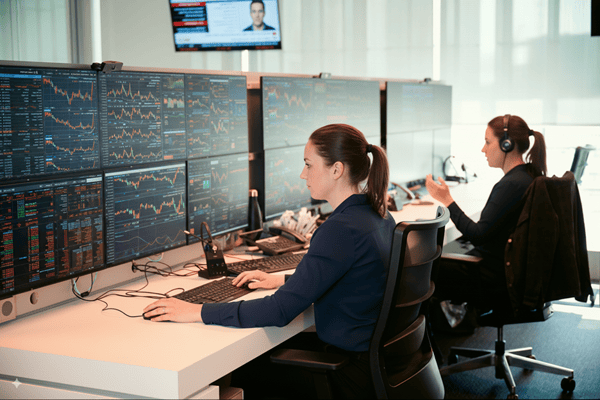
Quant traders use algorithms and statistical models to find trading opportunities, refining them against historical market data. It is a job at the intersection of finance and technology, and the day is shaped by two things: the market's clock, which you do not control, and the research work that only fits around it.
Where you sit changes the job more than the title suggests.
| Buy-side | Sell-side | |
|---|---|---|
| Who | Hedge funds, proprietary trading firms, asset managers | Investment banks and market-making firms |
| The mandate | Executing and optimising the firm's own strategies and portfolio | Market-making for clients, alongside some proprietary trading of the firm's capital |
| Who you talk to all day | Portfolio managers, quant researchers | The sales team and clients directly, often called Execution Traders |
| What the day's score is | Strategy P&L | Strategy P&L plus commission revenue from client trades |
The daily rhythm is the same on both sides though: rigorous analysis, fast decisions, and constant attention to the market.
- 1Before the open. Overnight markets, news and data, a team call, and a game plan.
- 2The open. Execution, at pace. Algorithms running under supervision and decisions made in seconds.
- 3Midday. Monitoring, risk and tech conversations, and hunting for fresh opportunities.
- 4The close and after. Final orders, reconciliation, P&L, then the research that could not happen earlier.
Before the open
The day starts early, often before sunrise, because the market you are about to trade has already been moving somewhere else.
Catching up on overnight
First is what happened while you slept. A US-based quant trader might log in by 7:00 AM to review live orders in European markets and the results of anything executed in Asia overnight. The job here is making sure the strategies are in sync with conditions globally: if something significant happened overseas, a surprise economic announcement or an abrupt move, you verify the models and positions are adjusted before your local market opens.
News, data and the morning call
Financial news, overnight data releases and relevant research, read for anything that could move the day's trades. Most teams then hold a short morning meeting. On the sell-side that often means a call spanning London, New York and Asia to recap everything since the previous close, so the desk aligns on the events likely to drive volatility, central bank announcements and earnings among them.
By the end of pre-market you have a plan: you know the news, your risk models are current, and you know which client orders or strategy signals you will be executing at the bell.
The open
At the opening bell the pace changes completely, and everything is about execution.
Getting trades done
The core responsibility is executing efficiently while minimising market impact. On the buy-side that means activating algorithmic strategies that send orders on the models' latest signals, under supervision. On the sell-side it is a mix of client orders and the firm's own positions, with electronic algorithms working large client orders so they fill at the best available prices without moving the market against themselves. Either way you are watching several screens of quotes, volumes and live P&L.
Deciding, fast
When a model flags an opportunity you decide whether to follow it or override it, and pausing an algorithm because an unexpected headline just landed is a normal call to have to make. This is the part of the job that market making games get closest to: our market games drill the same reflex of quoting, adjusting and deciding when the picture changes.
Communication runs alongside it. A buy-side trader keeps the portfolio manager informed of significant moves and strategy adjustments. A sell-side trader is in near-constant contact with sales and sometimes clients directly, and that side of the business remains as relationship-driven as ever, with traders talking to clients through the day to find trades that work for both.
Judgment on top of the models
Quant traders lean on automated systems, often ones they helped build, so their own attention goes to the strategic calls and the exceptions. When a price spikes unexpectedly they will dig into news feeds and order book data on the spot to work out whether it is noise to ignore or a signal to act on, then feed that read back alongside the model's output. It is a deliberate balance between trusting the algorithms and applying intuition built from experience.
Midday
The frenzy settles, but the day does not.
Traders rarely take a real lunch break, and usually eat at the desk. The reason is unsentimental: a few seconds of missed reaction time can be a meaningful P&L swing if the market moves against an open position. On some sell-side desks junior staff coordinate lunch deliveries, which tells you how firmly the desk expects everyone to stay at their screens.
Monitoring and adjusting
Positions, risk metrics and incoming data, continuously. You check the running algorithms are behaving and adjust parameters when the market's character changes, a sudden volatility spike or orders not filling as expected.
The conversations that happen now
Midday is when cross-team work fits. A quick exchange with the technology team about a minor software issue or an improvement to the trading system, kept short during market hours, though anything critical gets immediate engineering attention. Often a check-in with risk management too: after a volatile morning the risk manager will want an update on exposure and confirmation that positions sit inside approved limits.
That last one is a genuine skill. You have to explain complex quantitative exposures in plain terms, because the person asking is not going to be deep in your models or your code.
Looking for the next thing
On the sell-side this is detective work: using data and a network of contacts to find where supply and demand have come apart, then stepping in to trade or to put a client into it. On the buy-side the quieter stretch is for checking the models honestly, comparing the morning's predictions against what actually happened and flagging divergences worth watching in the afternoon.
The close and after
The final hour
The last hour can be as intense as the open. Large pending orders need completing while there is still liquidity, since the book thins near the close, and there are end-of-day auctions and closing price calculations to handle. Communication picks up again: a buy-side trader updates the portfolio manager on where the book stands and whether to hold overnight or exit, while a sell-side trader makes sure client orders are filled and often sends key clients a summary of the day, particularly if something notable happened.
After the bell
Trading stops; the day does not. Every trade gets booked and reconciled, and errors or mismatches found now rather than later. On the sell-side that includes sending clients confirmations and summaries with quantities, prices, fees and commissions, and coordinating with the back office on any settlement discrepancy. Then P&L: the immediate feedback loop on how the day went, and a large swing in either direction usually prompts a conversation with a manager or the risk team about what drove it.
The research window
Once the market is closed, the most valuable block of the day opens up. This is when backtesting and model simulation on fresh data actually happens, along with the research that had to wait. A trader might test how a candidate signal would have performed in that day's market, or go through the log of the day's algorithmic trades looking for inefficiencies or outright bugs in the execution code.
It is also when the relaxed versions of the earlier conversations happen: a debrief with quant research about a model in development, or a chat with an engineer about deploying an update. You write down what mattered, notes like "Model X under-predicted volatility in the afternoon" or "Strategy Y misbehaved around the midday spike", and by early evening you leave, already turning over how to be better positioned tomorrow.
Our strategy trainers are built around this half of the job rather than the execution half, working from the fundamentals of a product through to a live case, which is the closest thing to how a desk actually builds understanding of an instrument.
What the job actually rewards
A quant trader's day is a blend of rapid-fire execution and slow analysis, and the role demands switching between them. You need to trust empirical evidence and models, while developing enough intuition to notice when the market is behaving strangely and the model should be overridden. The hours are long and the learning does not stop, which is why quant trading is often described as a lifestyle rather than a job.
The part people underestimate is that it is not only maths, models and code. It is communication and teamwork: sharing insight with portfolio managers, coordinating with engineers, and working inside the limits risk managers set. The stakes are high and composure matters as much as cleverness, but the feedback is immediate, arriving as P&L every single day.
If that appeals, the way in is the interview. Our full guide to quant trading interviews covers the process end to end, the brainteaser database covers the problems firms actually ask, and make me a market covers the exercise that most resembles the job itself. When you know where you are applying, our firm pages collect the process and the practice for each one, and current openings are on our jobs board.