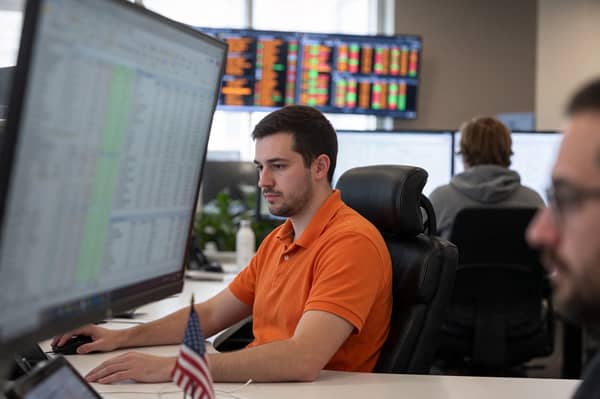
A quant, short for quantitative analyst, is a person who uses maths, statistics and programming to make decisions in financial markets. Most quants work at trading firms, hedge funds and banks in one of three jobs: the quant trader, who runs the trading; the quant researcher, who builds the models; and the quant developer, who builds the systems they run on.
This guide is about the person and the job. It covers what each kind of quant does all day, where quants work, what they earn, what the interview tests and how to become one. The detail comes from the interview processes we map in our firm guides, the firm assessments we rebuild for practice, and what candidates in our community report to us. Every pay figure comes from our salary pages, with its date. For the strategy side instead (how models trade and which strategies firms run), read What Is Quant Trading?.
What does "quant" mean?
"Quant" is short for quantitative. As a noun it means a person who works with numbers in finance: a quant at a trading firm, a team of quants at a bank. As an adjective it describes the work or the business: quant trading, a quant fund, a quant interview.
The word has three common uses, and they are easy to mix up:
- The person. The usual meaning, and the subject of this page: a specialist who applies maths and code to markets.
- The field. "Quant finance" is the whole area of applying maths to markets, from pricing derivatives to running a trading strategy.
- The token. Quant (QNT) is also the name of a cryptocurrency and the company behind it. It has nothing to do with quant jobs, which is why a search for "quant" shows coin prices next to career pages.
The long form, quantitative analyst, is still the usual job title at banks, for the people who price derivatives and measure risk. At trading firms and hedge funds the titles are quant trader, quant researcher and quant developer, and "quant" covers all of them.
What does a quant do?
A quant turns a market question into numbers and then into a decision or a system. The question can be "what price should we quote for this option?", "does this signal predict tomorrow's returns?" or "why did our orders reach the exchange a few microseconds late?". What the quant produces depends on the role.
| Role | Owns | What they produce in a week | Typical background | What the interview leans on |
|---|---|---|---|---|
| Quant trader | Live risk and profit and loss | Trading decisions, prices, changes to strategy settings | Maths, physics, engineering, economics | Mental maths, probability, market making games |
| Quant researcher | Signals and models | Tested research ideas, models, backtests | Maths, statistics, physics, computer science, often a PhD | Probability, statistics, research questions |
| Quant developer | Systems and infrastructure | Production code for trading, data and research | Computer science, software engineering | Coding, C++ or Python, systems design |
| Quantitative analyst (bank) | Pricing and risk models | Pricing libraries, risk models, model reviews | Financial engineering, maths | Stochastic calculus, probability, coding |
At a small firm one person can do two of these jobs. At a large firm they are separate teams with separate interviews. The difference between the first two is set out in Quant Trader vs Quant Researcher, and the third has its own guide, What Is a Quant Developer?.
What does a quant do all day?
The three roles often share a desk and always share a firm, but the days are very different. The trader's day follows the market's clock, the researcher's follows the research, and the developer's follows production.
One trading day, three jobs
| Part of the day | Quant trader | Quant researcher | Quant developer |
|---|---|---|---|
| Before the open | Reads overnight moves and news, checks positions and limits, agrees the plan for the day with the desk | Checks the tests and model runs that finished overnight | Checks overnight builds, exchange notices and configuration changes, and confirms that every system starts clean |
| The open | Watches the strategies start to trade and reacts in seconds when prices jump | Watches how the live models behave, then goes back to research | Watches production. A dropped data feed or a slow order path is fixed at once |
| Midday | Monitors risk, adjusts strategy settings, and talks to researchers and developers about what the market is doing | Cleans data, writes analysis code, tests an idea and tries to break the result | Works on the current project between alerts: a new exchange connection, a faster data handler, a tool the researchers asked for |
| The close | Manages the last orders and brings positions inside their limits | Prepares the tests that will run overnight | Prepares the changes that go out when trading stops |
| After the close | Reviews profit and loss and the trades that went wrong | Presents results to traders or portfolio managers and starts the overnight runs | Releases changes to the trading systems and checks them |
This is a typical day at a proprietary trading firm. The clock times depend on the market: a desk that trades US options and a desk that trades Asian futures keep different hours. At a hedge fund the researcher's column is most of the firm, and at a bank the day is set by clients and by pricing and risk deadlines.
Quant traders
As a quant trader, you watch the market and your strategies from before the open to after the close. Before the open you check overnight moves, news and positions. During the session you watch how the strategies trade, adjust their settings, and decide when a model should stop, for example when a headline arrives that the model cannot read. After the close you review the day's profit and loss, look for trades that went wrong, and work on improvements with the researchers.
At a market maker the trader also prices: you quote a bid and an offer, manage the inventory that the quotes leave you with, and hedge it. That is why trading interviews ask you to "make a market" out loud. The full hour-by-hour picture is in A Day in the Life of a Quant Trader.
Quant researchers
As a quant researcher, your day follows a slow loop: form an idea, test it on data, and usually throw it away. An idea can be a signal ("stocks that fell sharply this morning tend to recover by the close") or an improvement to a model the firm already trades. Most of the time goes to cleaning data, writing analysis code and checking that a result is real and not an accident of the test. A good week ends with one idea that survives. Researchers present their results to traders and portfolio managers, so writing and explaining matter more than people expect.
At a high-frequency firm the research horizon is seconds and the loop is short. At a systematic hedge fund it can be days or months, and one project can take a quarter. Our quant researcher interview guide explains how those firms hire.
Quant developers
As a quant developer, you write the software that the trading depends on: the systems that read market data, send orders to exchanges, run the risk checks and let researchers test ideas. On a low-latency team you spend the day on speed and correctness of the trading path, and changes go out after the close. On a research platform team you build backtesting tools, data pipelines and the environment the researchers work in. When production breaks during market hours, it is yours to fix now.
Quantitative analysts at banks
Banks use the title quantitative analyst. As a quantitative analyst at a bank you build the models that price derivatives and calculate risk. Some bank quants, often called strats or desk quants, sit on the trading floor and work with traders. Others work in risk or model validation, where the job is to check the models other teams built before the bank relies on them. The work uses more stochastic calculus than a trading firm role, the pace is slower, and the pay is lower.
Where do quants work?
Quants work wherever money is managed with models. Five kinds of employer hire most of them.
| Employer | What they do | Firms that hire quants | Main quant roles |
|---|---|---|---|
| Proprietary trading firms and market makers | Trade the firm's own money, often over seconds or less | Jane Street, Citadel Securities, Optiver, IMC, SIG, Hudson River Trading, Jump Trading, DRW, Flow Traders | Trader, researcher, developer |
| Quant hedge funds | Run systematic strategies with investors' money, over days to months | Two Sigma, D.E. Shaw, Renaissance Technologies, AQR, Man AHL, Qube, Squarepoint | Researcher, developer |
| Multi-manager platforms | Give capital to many independent teams, some of them systematic | Citadel, Millennium, Point72, Balyasny | Researcher, developer |
| Investment banks | Price and trade products for clients, manage risk | Goldman Sachs, JP Morgan, Morgan Stanley | Quantitative analyst, strat, developer |
| Asset managers and others | Build portfolios, run risk, trade crypto | Large asset managers, crypto market makers | Researcher, analyst |
The type of employer changes the job more than the title does. A quant researcher at a market maker works on short-horizon prices; a quant researcher at a hedge fund works on predictions over weeks. Our firm pages set out the process and the practice for each firm by name.
Is JP Morgan a quant firm?
No. JP Morgan is a bank that employs many quants, not a quant firm. A quant firm is one whose main business is trading with models, such as a market maker or a systematic hedge fund. Banks hire quants for pricing, risk and electronic trading, and since the Volcker Rule they take far less risk with their own money.
How much do quants make?
Quants are among the best-paid people in finance, and most of the difference between firms is in the bonus. In the US, top firms advertise a base salary of $300,000 for graduate traders: Jane Street, SIG and Hudson River Trading all state it in their job ads (checked September 2026). Across every firm that files trader salaries in US visa filings, the typical base is $165,000 to $250,000.
The bonus comes on top of the base. Our salary pages estimate US base plus bonus in the first year at $290,000 to $450,000 for a quant trader, $310,000 to $450,000 for a quant researcher and $295,000 to $510,000 for a quant developer (Tradermath estimates, September 2026). In London, recruiter surveys put a mid-level base at £90,000 to £130,000.
Do quants make 7 figures?
Some do, after several years at a top firm. Our estimate for a quant trader with 7 years or more in the US is $590,000 to $1.38 million a year, and $640,000 to $1.49 million for a researcher (September 2026). Jane Street paid $9.38 billion in total compensation in 2025, about $2.68 million per employee on average, a figure that includes its senior traders.
Most firms publish little, the bonus changes from year to year, and a first-year total often includes a signing bonus that does not repeat.
Every figure with its source is on our salary pages: quant trader, quant researcher and quant developer, and London pay by firm.
What skills does a quant need?
Every quant role needs three things: strong maths, especially probability; the ability to code; and clear thinking under pressure. How much of each depends on the role.
- Probability and statistics. Expected value, conditional probability and distributions come up in every quant interview, and they are the daily tools of researchers.
- Programming. Python is the minimum for nearly every role. C++ is the main language for low-latency developers and some traders.
- Mental arithmetic. Traders are tested on fast, accurate calculation without a calculator, because a price has to be right in seconds.
- Markets. Firms do not expect graduates to know finance, but they expect you to learn how an order book, a bid-ask spread and a hedge work.
- Communication. Traders, researchers and developers work as one team. A good idea that you cannot explain does not get traded.
What tools do quants use?
Python is the shared language: researchers use it with pandas and NumPy for analysis, and traders use it to look at their own data. Developers on the trading path write C++, and research platforms add SQL and, at some firms, the time-series database kdb+ with its language q. Bank quants mostly write C++ and Python for pricing libraries. Nearly all of it runs on Linux, and the code is kept in Git, as in any software team.
Is quant more maths or computer science?
It depends on the role. Researchers lean on maths and statistics, developers lean on computer science, and traders need fast maths and decisions more than either. All three need to code, and all three are tested on probability.
What is the quant interview like?
Most quant interviews follow the same shape: an online assessment, one or two technical interviews, and a final round of several interviews in one day. What the technical rounds test changes with the role.
- Online assessment. A timed test, usually the first real cut. For traders it is mental maths, number sequences and probability. Akuna and All Options give 80 arithmetic questions in 8 minutes, and Maven 50 in 5. Developers get a coding test.
- Technical interviews. Traders get brainteasers, probability and expected value questions, and market making games. Researchers get probability, statistics and questions on their own research. Developers get coding and systems questions.
- Final round. Back-to-back interviews, often with a trading game or a case, and a conversation about why you want the job.
Firms care more about how you reason than about the final number, so practise saying your working out loud. The trader process is set out stage by stage in our Ultimate Guide to Quant Trading Interviews, and the developer process in our quant developer interview guide.
Is being a quant hard?
Yes. Getting in is the hardest part: the top firms hire few graduates each year from a large pool of strong applicants, and the timed online assessment removes many of them before any interview. Once you are in, the work is demanding, strategies stop working and have to be replaced, and profit and loss is measured every day.
What makes it possible is that much of the interview can be trained. Mental maths, probability and brainteasers get faster with practice, and candidates in our community report that the timed assessment is where practice shows most clearly.
How do you become a quant?
There is no single route, but most people who become quants take the same steps.
- Study a quantitative subject. Maths, physics, computer science, statistics, engineering or economics with a strong maths component. Firms hire from all of them.
- Choose a role. Trader, researcher or developer. The choice decides what you practise, so read about each one before you apply.
- Learn to code. Python first, with pandas and NumPy. Add C++ if you want low-latency development.
- Build probability and mental maths. Work through probability problems until expected value is automatic, and train arithmetic under time pressure.
- Apply for internships. Internships are the main route into graduate quant jobs at trading firms, and applications open early, often in the autumn of the year before.
- Prepare for each firm. Formats differ by firm. Practise the assessment you will actually sit, and read the firm's process before each stage.
For research roles at hedge funds a PhD is common. For trading and development at proprietary trading firms it is rarely needed: these firms hire strong undergraduates and master's students every year.
FAQ
Is a quant the same as a quantitative analyst?
"Quant" is short for quantitative analyst, and the two are often used as synonyms. In practice "quant" is the wider word: it covers quant traders, researchers and developers at trading firms, while "quantitative analyst" usually means a quant at a bank.
What does being a quant mean?
It means your job is to make financial decisions, or build the systems behind them, with maths and code instead of judgement alone. A quant trader, a quant researcher and a quant developer all fit that description.
What are the big 4 quant firms?
There is no official list, and no four firms that everyone agrees on. Each person who uses the phrase names different firms, usually from the proprietary trading firms and quant hedge funds in the table above. Judge a firm by the role and the team it offers you, not by a list.
What qualifications do you need to be a quant?
A degree in a quantitative subject is the usual minimum: maths, physics, computer science, statistics or engineering. Trading and developer roles hire from bachelor's and master's degrees; research roles at hedge funds often prefer a PhD.
How many years does it take to become a quant?
Most graduate quants are hired straight from a bachelor's or master's degree, so three to six years of university is the usual route, with at least one internship on the way. A PhD usually adds three to five years and is mainly needed for research roles at hedge funds.
Do you need a PhD to be a quant?
Not for most roles. Trading and development roles at proprietary trading firms rarely need one. Research roles at systematic hedge funds often prefer one.
Do you need a master's in financial engineering or a certificate such as the CQF?
No. Trading firms test you directly in their interviews and hire from maths, physics, computer science and engineering degrees. A master's in financial engineering is a common route into bank quant roles, and the Certificate in Quantitative Finance (CQF) is a part-time professional course that fits bank and risk roles better than trading firms.
What is the difference between a quant and a data scientist?
Both build models from data with statistics and code. A quant's model sets a price or makes a trade, the data is noisy market data, and the result is measured in profit and loss every day. The skills overlap, and data scientists do move into quant research, but the quant interview tests more probability and, for traders, mental maths.
Do quants work long hours?
Quant traders work the hours of the market they trade, plus preparation before the open and review after the close, so their days are long and fixed. Researchers and developers usually have more regular hours, with longer days before a deadline or when a production system breaks.
Can you become a quant from a non-finance background?
Yes. Firms do not expect graduates to know finance; they teach the markets on the job. What they test is maths, probability, coding and how you reason, so a physics or computer science student starts in a good position.
Start preparing
The first test on the way to most quant trading jobs is a timed mental maths assessment, and it is the part that improves fastest with practice. Start with the Math Trainer, then add the probability and brainteaser practice above. If you are aiming at development, our coding practice is where to begin instead.
If you would rather follow one plan, the Trader Track, Researcher Track and Developer Track put the lessons, drills and firm assessments for each role in order.
This site is protected by reCAPTCHA and the Google Privacy Policy and Terms of Service apply.