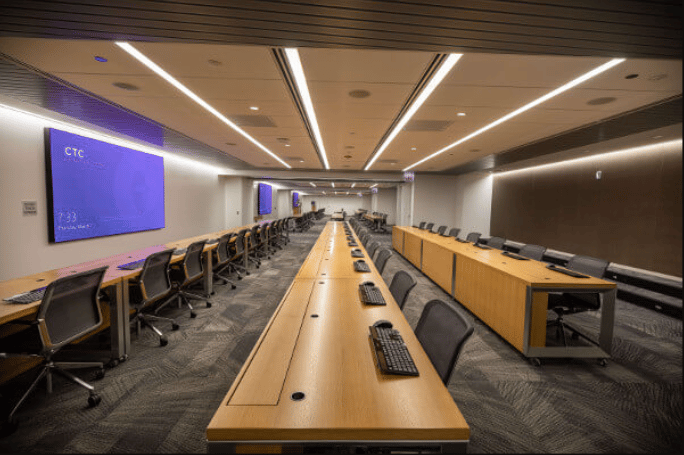
Chicago Trading Company has been making markets in options since 1995, and is still one of the defining derivatives firms in Chicago, with desks in New York, London and Amsterdam. Options market making sits at the core of the business, so the interview leans harder on derivatives intuition, raw calculation speed and live trading behaviour than most quantitative processes you will meet.
Worth reading alongside this guide: CTC's own campus page, which sets out their side of the process and the internship structure.
- 1Online assessment. Logical reasoning, pattern recognition and speed, under severe time pressure.
- 2Recorded video interview. One-way and behavioural, with roughly 30 seconds to think before each answer.
- 3Technical interview. 30 to 45 minutes on mental maths, probability, expected value and brainteasers.
- 4Final round. A day in the Chicago office built around a mock trading session.
Stage 1: Online assessment
Once your application clears the initial screen you are sent an online assessment. What you get depends on the track you applied to.
| Track | What you sit | What it covers |
|---|---|---|
| Trading and quant | A cognitive aptitude test, usually followed by an untimed personality questionnaire | Timed logic problems, verbal analogies, numerical word problems and pattern recognition. Reports vary, but some candidates describe under 20 seconds a question |
| Software engineering | A proctored cognitive assessment of roughly 30 minutes, then a Codility coding test | Older cycles used HackerRank-style problems instead |
CTC gives you practice tests before the live assessment. Take them. The format is a large part of the difficulty, and candidates who go in cold lose time to navigation rather than to the questions.
Passing the assessment does not guarantee an interview. Your resume is reviewed again afterwards, and plenty of candidates score well and still do not advance.
How to prepare
- Arithmetic, daily, on the Math Trainer. Push for speed once your accuracy is stable.
- Pattern recognition, until the standard families are instant. The Sequence Trainer covers the range, and our guide to sequence problems explains what to look for.
- Logic and probability, worked under a timer rather than at your own pace. The brainteasers are the drill.
- Fraction to decimal conversion, until it takes no thought at all, on the fractions to decimals trainer and in our step-by-step guide.
- Algorithms, for engineering roles, on easy to medium problems built around arrays, loops and basic data structures.
Stage 2: Recorded video interview
Trading candidates who clear the assessment are usually invited to a one-way recorded interview. Questions appear on screen and you record your answer immediately, often with around 30 seconds of thinking time. There is no interviewer to read, and no second take.
The content is almost entirely behavioural, so prepare the whole set rather than a few:
- Why do you want to become a trader?
- Why CTC over other firms?
- Are you a competitive person?
- What sets you apart from other applicants?
- Walk me through your resume.
How to prepare
Record yourself answering each one in 60 to 90 seconds and watch it back, because most candidates ramble far more than they think. Lead with your conclusion and then support it: CTC is screening for fast, structured thinkers and the format rewards exactly that. Have a specific reason for choosing CTC, since "I want to work in trading" is not an answer to "why CTC". Treat the 30 second prep window as real time, sketch a three-point structure, and speak to it rather than improvising.
Stage 3: Technical interview
A phone or on-campus round, in some cycles conducted by alumni of your university. It usually runs 30 to 45 minutes and mixes technical questions with a discussion of your resume.
What they cover
- Mental maths. Rapid arithmetic, fraction to decimal conversion, percentages and multi-digit multiplication, all on the Math Trainer.
- Probability and expected value. Dice and coin problems, conditional probability, Bayes' theorem and expected value. The probability and statistics course covers the ground and the probability questions drill it.
- Brainteasers. Weighing puzzles, counting problems and multistep logic. Work the reasoning puzzles.
- Fermi estimation. CTC often asks how confident you are in your answer, so be ready to attach a range. Practise on the Fermi questions and the timed Fermi game.
- Resume validation. Detailed questioning on anything technical you have listed. Candidates who mention programming are frequently asked coding and algorithm questions even in trading interviews.
Engineering candidates get a genuinely low-level screen instead. Reported topics include C++ move semantics, memory management, concurrency, collision resolution and cache behaviour, including why a hash table lookup misses cache.
How to prepare
Never solve silently. CTC is grading your method and your speed, and a clean approach with a small slip beats a correct answer delivered in silence. Practise under artificial pressure, with someone quizzing you out loud while a timer runs. Do not list anything on your resume you cannot defend in depth. For estimation questions, state your assumption chain and finish with a confidence range rather than a single number.
The C++ and concurrency territory of these rounds is practisable directly:
Stage 4: Final round, the superday
A day in the Chicago office: an office tour, sessions with senior leadership, a desk shadow and, above all, a mock trading session. Candidates report roughly 4 to 6 one-to-one interviews alongside the trading component, and some cycles have added a timed test or a case study.
What the day contains
- Mock trading. CTC simulates a trading floor and you trade against other candidates and against interviewers. This is the centrepiece of the day.
- Market making exercises. Quoting two-way markets on statistics, dice outcomes and hypothetical payoffs, then managing the position you build.
- Advanced technical questions. Layered probability, multistep expected value and harder brainteasers.
- Derivatives knowledge. Put-call parity, synthetic positions, the Greeks and how delta and gamma behave as spot moves, implied versus realised volatility, skew, spreads and pin risk. The Options Strategy Trainer works through parity, spreads and replication directly, and the option theory questions and markets, trading and risk course cover the rest of the level expected.
- Behavioural interviews. Deep dives on your background, your motivation and how you handle being wrong.
The mock trading session carries more weight here than at almost any other firm on this site. You can be excellent at probability and still fail the day if you freeze when it is time to put a price up and trade on it.
How to prepare
- Quote out loud before the day. Read our guide to make me a market, then play the market games repeatedly against real opponents rather than reading about them.
- Move your market after every trade. Failing to update after being hit or lifted is the single clearest signal that you do not understand information flow.
- Know your options cold. For an options market maker, vague answers on the Greeks or parity are a serious problem however strong your probability is.
- Trade. Candidates who quote wide and never transact are read as passive. CTC wants to see calculated aggression, and then a clear justification of the risk you took on.
- Reset between sessions. Each interviewer forms an independent view, so a round that went badly does not follow you into the next one.
Closing remarks
Two things separate CTC from most firms on this site. The first is how much weight sits on the mock trading session, so build that muscle early rather than treating market making games as the last thing you prepare.
The second is options. CTC is an options market maker first, and candidates consistently underestimate how much derivatives intuition is expected relative to other quantitative processes. Knowing that gamma is the rate of change of delta is table stakes. Reasoning out loud about what happens to a position when spot drifts and volatility rises is what actually gets you through.
Speed underpins all of it. Every stage, from an assessment that gives you seconds a question to a video round that gives you 30 seconds to think, is built to find people who are fast as well as correct. Being right slowly is not a passing grade here.
Work through everything we have for Chicago Trading Company, and read our full interview guide for how these stages compare across firms.