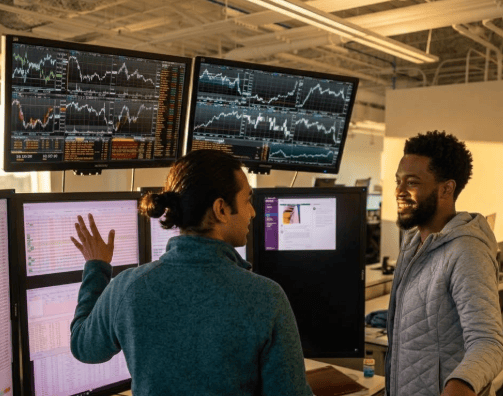
Valkyrie Trading is a Chicago proprietary trading firm formed in 2011. It has no investors or clients, trades only its own capital, and makes markets in options and other derivatives, mostly quantitatively and electronically while keeping links to the floor and over-the-counter markets. It has one office, on South Financial Place, and somewhere between 50 and 70 people.
Two hiring facts changed in 2026. Valkyrie is running no fall, spring or summer internships in the 2026 to 2027 academic year, and the student route is a one-week Trading Boot Camp in May. And the junior derivatives trader posting from August 2026 requires valid, ongoing, unrestricted authorisation to work in the United States without sponsorship. The firm sponsored junior traders as recently as 2024, so this is new.
The junior derivatives trader online assessment is a timed HackerRank test of number sequences and probability. Since about September 2024 it has also carried one short coding task. The old version was 20 questions in 30 minutes with no coding. The current one is 12 to 13 questions plus the coding task, on a clock reported as either 30 minutes in total or 25 minutes for the maths and 25 for the coding.
- 1Online assessment. Sequences and probability on HackerRank, plus a coding task.
- 2Recruiter screen. 30 to 60 minutes: your resume, motivation, and more mental maths, sequences and probability.
- 3Trader call. A probability conversation with a trader.
- 4Final round. About 6 hours in person in Chicago: written tests on arithmetic and sequences, then a market making game with traders.
Candidates describe the process taking about 3 weeks to a month. In 2022 and 2023 the test arrived 1 to 2 days after applying and each stage followed the last by a day. The test can now take up to a month to arrive. Another passed it and was then told the positions had been filled through the Boot Camp, so a strong test is not a guaranteed interview.
Roles for students and graduates
| Role | Window | Notes |
|---|---|---|
| Junior Derivatives Trader | Posted 11 August 2026. A Harvard listing ran from 31 July to 12 September 2026. Start between January and August 2027 | $140,000 base plus a discretionary bonus. A degree in maths, physics, engineering, CS or equivalent, and Python or R. After a training programme with several weeks of live trading you join a team under a senior trader |
| Trading Boot Camp | Held 18 to 22 May 2026 for students graduating between December 2026 and December 2027. Register interest through the careers page | One week in Chicago of mock trading, trading games and courses on options market making. Stipend, flights and housing, and consideration for full-time employment |
| Trading internship | Discontinued for 2026 to 2027 | Past titles included trading, quant trader and quant researcher interns |
| Junior Software Engineer | Listed in 2026 at $140,000 | C++ or C# required, with its own 2 coding tests |
| Junior Quantitative Trader and Researcher | Reports from 2024 and 2025 | No graduate posting was live in October 2026 |
Stage 1: Online assessment
The current format, September 2024 to 2026
| Item | What candidates report |
|---|---|
| Platform | HackerRank, in one September 2024 report. A 2026 report does not name it |
| Content | 12 to 13 questions of sequences and probability, then 1 small coding task. Confirmed by 3 reports |
| Time | 30 minutes in total in one September 2024 report, or 2 parts of about 25 minutes each in one May 2026 report, where the candidate was not sure |
| Pace | About 2 minutes per maths item either way |
| Coding task | A regular expression for an email address that may contain an underscore. The prompt had incomplete instructions and no predefined function |
| Mental maths | Arithmetic may appear alongside the sequences and probability |
| Difficulty | Easy overall, but the sequences are tricky if you do not spot the pattern at once |
| Scoring, retakes, proctoring, invitation text | No reports |
The classic format, 2022 to 2023
20 questions in 30 minutes: 10 sequences first, then 10 probability, statistics and simple finance questions, typed answers, 1 overall clock, a 7-day window, and the test arriving a day or two after applying. Candidates say each person's questions are similar with the numbers changed, so learn the pattern families rather than answers.
Reported sequences across both formats: 1, 3, 0, 5, -2, 11. 2, 1, 3, -1, 7. 114, 57, 60, 30, 15, 18. 3, 10, 29, 84, 247. -8, 57, -333, 2007, -12033. 6, 3, 10, 5, 26, 13, 170, 85. 2, -1, 6, 7, 18, 23. Candidates describe the family as alternating and interleaved patterns that need mental arithmetic.
Reported probability and finance: the probability of k consecutive heads in n tosses, exactly two 1s when rolling five dice, the sum of two 20-sided dice equalling 17, the expected total of six 10-sided dice, 4 black balls among 20 with none adjacent, how many people produce 200 handshakes, a break-even price, and a 2-day net percentage change.
Nothing in the record describes a separate quantitative assessment as a third test for this role. The closest things are the 2026 two-part split and the written tests at the final round. If you have sat the test recently, tell us what you saw.
Tests for other roles
| Role | Reported format |
|---|---|
| Junior Quantitative Trader (2024) | 13 to 15 questions in 75 to 100 minutes: 10 or 11 probability questions on expectation, variance, combinations and Bayes, plus 3 or 4 coding questions on lambda functions and pandas. A Green Book boy or girl problem appeared |
| Quant Trader Intern | 45 minutes: 5 sequences, 6 to 7 hard probability questions, 2 programming questions |
| Quantitative Researcher Intern (2023 to 2024) | 13 questions in 45 to 90 minutes: 2 or 3 sequences, 7 or 8 probability and statistics, 3 coding on caches, recursion or object-oriented design |
| Junior Quantitative Researcher (October 2025) | 1 hour: a SQL join across 4 tables, 3 pandas or numpy questions on averages, variance and groupby, and 5 statistics questions. Not hard, but tight on time |
| Junior Software Engineer | 2 tests in C++ or C#: 2 questions in 120 minutes such as a binary search tree and a largest bordered subsquare, then a 90-minute object-oriented test. 4 questions in 3 hours |
How to prepare
- Sequences. Drill alternating and interleaved patterns and sign-alternating multiplicative ones on the Sequence Trainer, and read our guide to number sequence tests for the families.
- Probability with typed answers. Dice and coin counting, expected values of sums, consecutive runs, and the Green Book reroll problem, on the probability trainer and the cards and coins collection. You need a number, fast, not a method.
- Arithmetic. Percentages and break-evens on the Math Trainer.
- The coding task. Revise regular expressions and basic Python string handling, and practise writing a function from an under-specified prompt.
- The clock. Finish the maths with time to spare for the coding task.
Stage 2: Recruiter screen
30 to 60 minutes by phone or video, half behavioural and half technical. Expect a deep dive into your resume, then about 2 mental maths questions, 2 sequences and 2 statistics questions, such as the Green Book expected value reroll problem or deriving a standard deviation from a mean. Another got an hour of background, behavioural questions and more sequences and probability. Some candidates get a recorded video interview instead, straight after the test, answering sequences and probability questions to a camera. No other candidate reports that stage.
Motivation questions: why trading, and why trading over quant research or academia. Options questions: what delta is, the Greeks, the volatility curve, skewness and kurtosis, and how familiar you are with options.
How to prepare
Know why you want to trade and why a market maker rather than a research seat. Learn the options vocabulary from the options strategy trainer and the making markets in options lesson.
Stage 3: Trader call
A call with a trader after the recruiter screen. The one reported question is the expected number of rolls to get two 5s in a row with a die. The trader call does eliminate candidates. The Markov chain lesson covers the method for every question of that family.
Stage 4: Final round in Chicago
About 6 hours in person. Candidates describe 3 written tests and a behavioural and market making session with traders: arithmetic and sequence exams on paper or online, then a probability card game played against other traders, described as similar to poker but pricing straddles and the expected value of card draws, and a market on the sum of cards. Options theory comes up: Black-Scholes assumptions, how to find an arbitrage in real market making, and what risks a market making firm has. A remote version has also run: 3 people on a Zoom call, mostly behavioural, with some maths and a demanding market making game at the end.
Candidates are blunt about the day: more than half of it spent on written tests that could have been done online, and one flown out to sit another 3-hour test in a room.
How to prepare
Keep the arithmetic and sequence drills going until the day, because they come back on paper. Practise quoting out loud on the card game and the dice game, and read our guide to make me a market. Be able to price a straddle from a distribution of card draws and to name the Black-Scholes assumptions and what breaks each one.
Key tips for success
- Prepare for the current test and keep the classic one in mind: 12 to 13 maths items then a coding task, or 20 items with no coding.
- Learn pattern families, not answers. The numbers change between candidates.
- Leave time for the coding task and revise regular expressions beforehand.
- Bring options vocabulary to every call: delta, the Greeks, the volatility curve, Black-Scholes assumptions, straddles.
- Check the work authorisation line before you apply. The 2026 posting excludes anyone who needs sponsorship.
Closing remarks
Valkyrie's process is a sequences and probability test with a coding task bolted on, a recruiter who asks the same families aloud, a trader who asks one good probability question, and a long Chicago day of written tests and a card market. Candidates who recognise sequence patterns on sight, give typed probability answers fast, and can quote a market on a card draw get through. The rest fall at the pace or the pattern recognition.
Work through everything we have for Valkyrie, and read our full interview guide for how these stages compare across firms.