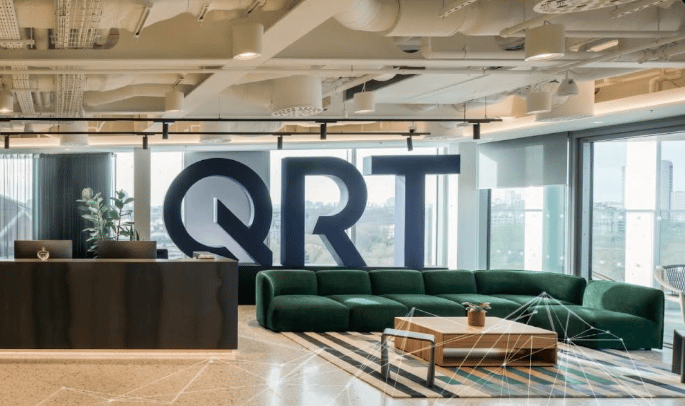
Qube Research & Technologies is a quantitative and systematic investment manager that trades liquid asset classes across the world, from high to low frequency. It began as a Credit Suisse fund in late 2016 and became independent through a management buyout at the start of 2018. It is headquartered in London, says it has over 2,000 employees across 16 offices, and was reported to manage around $38bn to $42bn in early 2026. Paris, Zurich, Geneva, Dubai, Hong Kong, Singapore and New York are among the offices, and the 2027 internship postings add Aarhus and Budapest.
Two things about QRT shape its hiring. You apply to one location, and the firm matches you to a team during the process rather than before it. The process is therefore team dependent: candidates report different numbers of rounds, different interviewers, and sometimes no online test at all.
The first stage for quantitative research is not a mental maths test and not a pure coding test. Candidates describe a 90-minute, webcam-proctored HackerRank assessment of around 20 statistics and machine learning multiple-choice questions plus 3 coding tasks, one of them a data science exercise. Prepare for it like a statistics and machine learning exam with a coding section, not like a trading firm's arithmetic screen.
- 1Application with written answers. Short motivation questions that the firm says it reads carefully.
- 2Online assessment. 90 minutes of statistics and machine learning multiple choice plus coding. Some applicants skip it and go straight to interviews.
- 3Technical interviews. 2 to 5 remote rounds on regression, statistics, machine learning, probability, coding and your projects.
- 4Onsite final. An assessment centre in London for technology roles, or a Paris superday of 2 to 3 interviews for research.
Candidates describe the quantitative research internship process taking about 5 weeks on average, with individual processes ranging from 2 weeks to 3 months. Some candidates never receive a test and are routed straight to a technical interview, so prepare the interview material from the day you apply.
The 2027 programmes
QRT restructured its early careers roles in September 2026. Applications are reviewed on a rolling basis and the firm recommends applying early. A previous London listing closed in early November, so treat October as late.
| Programme | Locations | Length | Who |
|---|---|---|---|
| Internship, Quantitative Research and Trading (EMEA) | Aarhus, Budapest, Dubai, Geneva, London, Paris, Zurich | 4 to 6 months in 2027 | Penultimate or final-year bachelor's, master's or PhD students. Some permanent conversions |
| Internship or Graduate, Quantitative Research and Trading (Asia) | Hong Kong, Singapore, Shanghai, Beijing | 3 to 6 months | Same |
| Internship, Software Engineering and Quantitative Development | London, Zurich, Wrocław, Paris, Dubai, plus others by version | 3 to 6 months, or a 12-month placement for software engineering | Penultimate or final year, on track for a 2:1 or above |
| Internship or Graduate, Software Engineer and Quantitative Developer (Asia) | Hong Kong, Singapore | 3 to 6 months | Penultimate or final year |
| Quantitative Research, PhD and Postdoc | London, Paris, Zurich | Full time | Final-year PhD students and postdocs |
The application form asks what makes QRT attractive to you, what draws you to a hedge fund, and for the technology roles, which aspect of software engineering excites you most. The research form asks for an 80 to 100 word answer. Write something specific, because the firm says thoughtful answers help.
QRT also runs a secondary route. Its 2026 task on the ENS Challenge Data platform, on asset allocation performance forecasting, carries the note that strong performance may lead to direct follow-up from the team.
Stage 1: Online assessment
The main format, reported for research internships from 2024 to 2026, looks like this.
| Item | What candidates report |
|---|---|
| Platform | HackerRank, named in one report. Several candidates say the webcam must stay on |
| Length | 90 minutes on one overall clock |
| Content | About 20 statistics and machine learning multiple-choice questions, then 3 coding questions, one of which is a data science task. About 23 questions in total |
| Pace | About 4 minutes per item on average, but the coding tasks take most of the time |
| Difficulty | The multiple choice is described as fairly easy and the overall level as not hard. Several candidates say the time was barely enough |
| Question bank | The questions seem to be drawn at random from a bank |
| Scoring | Not published. Running out of time on one part does not rule out a first round |
Reported multiple-choice topics include statistical tests and goodness of fit, linear regression, general machine learning and reinforcement learning vocabulary. The first coding question has been described as easy and similar to a LeetCode string conversion problem. The data science coding task is the time sink, so plan your time before you start it.
Other formats circulating
- Coding only. Research candidates in earlier years describe 3 or 4 coding questions in 1 hour, and recent full-time versions in Hong Kong have been 3 LeetCode medium problems.
- Developer tests. Software engineering and quantitative developer applicants report HackerRank tests of LeetCode-style problems mixed with multiple choice on language features and computer science. Quantitative developer tests in London can mix pandas aggregation questions with an algorithm problem.
- Codility. Reported only for experienced and data roles. The 90-minute data engineering Codility test has a high bar: a score in the mid 80s can fall short.
- No test. Several research candidates went straight to technical interviews.
The invitation wording, the time you get to sit the test, retakes, back navigation and calculator rules are not reported anywhere. If you have sat the test recently, tell us what you saw and we will update this guide.
How to prepare
- Statistics and machine learning theory. Hypothesis tests and goodness of fit, p-values, the assumptions of OLS, bias and variance, ridge and lasso, tree ensembles and basic reinforcement learning vocabulary. The machine learning course covers the ground.
- Coding under a clock. 2 to 3 LeetCode easy and medium problems in 60 minutes, in Python, from the coding practice catalog.
- One pandas task under time. A groupby, a merge and a rolling statistic on a small dataset, done without looking anything up. The quant Python lessons are the right level.
- The camera. Practise a full timed run with your webcam on, because several candidates mention it.
Stage 2: Technical interviews
Between 2 and 5 remote rounds on Teams or Zoom, usually 45 minutes each. Reported shapes include 3 Zoom rounds, a 45-minute call followed by 2 back-to-back 45-minute sessions, and an HR call plus a junior researcher plus a senior researcher. Your first round may be with a junior researcher.
What they cover
- Regression. The OLS estimator and how to derive it, which penalised regressions have a closed form (ridge does, lasso does not), penalisation in general, and the slope of y on x against the slope of x on y. Candidates report these in almost every process.
- Statistics. t-statistics, z-scores and p-values, coin-toss statistics, correlation against causation, overfitting, and realised against implied volatility.
- Machine learning. Random forest against XGBoost, k-nearest neighbours, what a positive semi-definite matrix is, machine learning under correlation and in high dimensions.
- Probability and counting. Conditional probability, a classic random walk exercise, counting permutations, and the number of paths from flat to long 10 of one asset and short 10 of another.
- Coding. One round was live coding only, refactoring code the interviewer provided. Developer candidates report pair coding with a manager, data structures, syntax, multithreading and databases at LeetCode easy to medium.
- Your CV. Candidates describe a lot of in-depth questions about their projects. One Hong Kong round focused on Python skills without live coding and on market intuition.
No market making game has been reported at any stage.
How to prepare
Derive OLS by hand and know the ridge and lasso closed forms, or lack of one. Work through hypothesis testing and correlation against causation, then bagging and boosting until you can say when you would pick each. The Markov chain lesson covers the random walk reasoning, and the probability questions cover the conditional probability and counting.
Prepare a 2-minute and a 10-minute version of every project on your CV. Interviewers at QRT go deep on them.
Stage 3: Onsite final
The final stage is in person. For technology roles the firm calls it an assessment centre at the London office: candidates report 3 interviews, 2 technical and 1 behavioural. For research in Paris candidates call it a superday of 2 to 3 interviews, chosen by team need, and describe it as less academic than the earlier rounds: what strategy would you build, and which features would you use.
Two other shapes are reported. Some research internships add a practical machine learning project of about 2 weeks between the theory interview and the final, which you then defend before a longer onsite. A data challenge can sit between the first call and an onsite of 4 interviews of 45 minutes with different teams, and the 2025 London research internship listing mentions one too.
How to prepare
Have an answer to "what strategy would you build and which features would you use" ready before the day. Use the validation course and our backtesting interview questions to make sure the answer survives questions on leakage and overfitting. If a project lands between rounds, treat it as the interview and present it as research: the question, the data, the validation and the result.
Key tips for success
- Prepare for a statistics and machine learning exam, not an arithmetic screen. There are no sequences and no 80-in-8 style drills in any candidate report.
- Plan the test clock around the data science coding task. Bank the multiple choice quickly and leave the algorithm questions polished only if there is time.
- Start interview preparation on the day you apply. Some applicants are interviewed with no test at all, sometimes within days.
- Expect silence. Candidates report no reply after the test and no decision after late rounds. Keep other applications moving and follow up once.
- Enter the ENS data challenge if you have the time. The firm says strong performance leads to direct follow-up.
Closing remarks
QRT hires researchers who know statistics and machine learning in depth and can code. The test checks that quickly, the interviews check it again in conversation, and the final asks what you would do with it. Candidates who treat it like a trading firm's process, all speed and no theory, do not get far.
The process itself is uneven. The number of rounds, the interviewer's seniority and whether a project appears all depend on the team you are matched with, and the firm does not always say where you stand. Judge your progress by what you have done, not by how long you have waited. Work through everything we have for QRT, read our quant researcher interview process guide for how the stages compare across firm types, and our full interview guide for the trading-firm version of the funnel.